Tuesday, January 27, 2015

New Year, New Term, New Mindset


As I start my second round of site visits after a relaxing break, I am starting to re-examine how I will approach my work.  I learned a lot not just during the first term, but also over the course of my month in Johannesburg.  As opposed to last year, when I went in almost totally blind, I feel prepared and excited.  I also feel scared, because knowing more in some ways made me see the cracks in the program, which are inevitable, but much more visible to me now. 

I’ve learned, most importantly, to take what other people tell me with a grain of salt.  Although my supervisor is more experienced and knows more about the project overall than I do, I can’t take everything she says without testing some of it myself.  Of course most of what she advises me on it amazing and helpful and informed, but I have now spent more time out on the sites than she has, and I understand some nuances that are not immediately apparent.  It starts from the most simple, personal things, and carries out to how I view the project.  Its not that there were any big hidden secrets I discovered, more of the natural progression of becoming comfortable at a job, combined with the larger picture of me becoming more confident as a professional and a development practitioner. 

Small thing:  I was told to pack pants for work because I would feel more comfortable riding motorbikes to work, and the teachers would be ok with me wearing pants (female teachers usually wear skirts).  This time around I am packing long skirts that I can wear on the motorbike and make me feel like I stand out just a tad less in town and at school.

Bigger thing:  Some of the staff members are ashamed of their lack of confidence and skill with the equipment, so they fabricate stories about having used it in their reports.  I was told that one site needed a lot less support because their reports and deliverables had been really good, but it turned out that they had been relying on one teacher while most of the staff was almost completely computer illiterate.  While this has been working fine in terms of their reports and presenting a successful project on paper, it doesn’t sit well with me because it is not helping achieve our broader goals.  I will work much harder with that site this term.

Wish me luck as I continue my Kenyan saga, I’m sure many more surprises, challenges, and successes lie ahead.

Sunday, January 18, 2015

Killing Time in Luhyaland

Even though my job keeps me busy, I make sure that after 7 or so I make my time free.  Oddly enough, this is the hardest time for me to fill when I am out in the sugarcane field that is Western or in the desert up North.  I end up with plenty of free time in Rongai too, provided I haven’t tried to get anywhere that day and ended up in two hours of traffic.  I have devised some hobbies to relax my mind and keep me chilled out when it gets dark and I’m sitting in my room, a bottle of DOOM mosquito spray poised ever-ready on the bed. 
First, I have gotten back into drawing, which I did a lot during college.  I do the same abstract pen drawings as before, which have always had some Moroccan stylings and lots of detail, but they are becoming much more informed by the fabrics and textiles I see around me every day.  After my trip to Lamu, they are also much more Swahili-influenced.  For a few years I avoided color and drew in mostly black and white, but these days I have combined my styles, using intricate colored patterns that are set off with a solid black background. 
Reading is still a huge hobby, and I have read a lot of books since I arrived, most memorably the Kwani? Anthologies of stories written by Kenyan and other African writers on topics including the Kennedy airlifts of East African students to Universities in the US, the diaspora, dating, visiting your mom in the village, killing chickens, and hacking computers.  I have also enjoyed some true crime novels, weepy stories about heroic elephants (sorry mom), and am currently reading Obama’s Dreams from my Father.  I try to read Kenyan authors when I can, but they are not featured prominently in bookstores here.  Actually, the easiest things to find are Christian novels and self-help books.  At a premium, too.  Books are about 30 dollars at the cheapest here.
Podcasts have become a tidy little obsession that I can lose myself in while I go to sleep.  I love how I can download a bunch, listen to them a few times, and then my iPad deletes them for me.  No fuss, no muss.  Serial was a big part of my life in Joburg.  Also into crime podcasts.  I’m not a weirdo, I just find them soothing or something.   They are so clinical and straightforward, surprisingly.

I also like to just get out and walk around town.  There is not a lot to see in Mumias, but the markets are still fun to walk through.  Lots of wheelbarrows full of mangoes, hawkers selling pirated dvds and schoolbooks, fabric shops, and second hand clothing.  It can be frustrating because people never leave me alone when I am out walking, but putting up headphones that aren’t attached to anything usually does the trick.  Sometimes I want to talk to people and I do, but often I just want to be left alone to wander. 

The strike was called off and I return to work on Monday, but I’m not sure what the environment at the school will be like.  I’m guessing that the teachers will be pretty stressed and busy, so I don’t want to get in the way.  I hope my time in Western isn’t wasted.

Tuesday, January 13, 2015

Back to Western

This week I returned to Mumias town in Western Kenya to do my second stay at Munanga School.  However, things are different this time around for a few reasons.  One, I have come back from visiting all the schools and having spent 4 months in Kenya a little wiser and more prepared to work with the particular difficulties of this rural school.  Two, I feel like I understand the project as a whole much better after staying in Joburg at the head office for a month.  And… well scratch all of that, because, three, everything is very different this time around because the teachers are all on strike.  Kenyan public school teachers struggle with low wages, unpaid wages, overfilled classes, lack of supplies and resources, and long hours.  Last year the strike lasted for three weeks, and currently one week has passed.  However, I have still been sent out to Western with little direction for what I am supposed to do.  The teachers legally cannot enter the school, and it is a sensitive issue to ask them to work on school-related projects with me while they are striking.
I do have a lot of new projects to work on while I hang out in the hotel, however.  I have been given a Raspberry Pi to experiment with as a computing device to use in classrooms, a BRCK wireless router that uses a SIM card to connect to networks and has a built-in power supply, a new laptop (courtesy of Our Lady of Peace School), and a new tablet.  These things should all come together to create a much more productive environment for the school staff.

However, they have to be actually working to use everything, so until then I am waiting, watching movies, and fiddling with the Pi.  Wish me luck!

Saturday, January 3, 2015

A Famtastic Christmas

I got a very special Christmas present this year—my mom and sister came to visit me in Kenya!  I got back here from Johannesburg on December 19th and they arrived on December 23rd.   I picked them up at the airport very late and they were still willing to open their suitcases that were full of treasures for me.   I’m currently drinking a lovely cup of coffee from the French press they brought me.

On the first day we kept things pretty chill and had lunch with D at Galleria mall.  After some relaxing, we had dinner at nearby Osoita, which inexplicably took about 3 hours.  The food was pretty good, but Amy’s pizza didn’t come until we were ready to leave. 

On Christmas we went back to the airport because I decided I do not like my family and wanted to send them back to USA.  Just kidding.  We caught a short flight on a little propeller plane to Lamu, and island on the coast.  The plane stopped in Malindi to let most of the passenger out and pick up a few more, including Sonia!  She took a bus all the way from Mombasa to have Christmas with us.  We landed in sticky hot Manda Island at noon and met W, who I would have worked at if I had been able to go to my original internship on Lamu island.  I wasn’t allowed to go because of the security situation there, but it has improved a lot, so we were able to go there for our holiday.  We still got a lot of side-eyes from people who thought we shouldn’t go to Lamu, but the island is very safe.  We steered clear of the mainland and all pirates.

We spent the next few days laying on the beach, swimming in the beautiful Indian Ocean, and exploring Lamu town, a very old Swahili town that is also a UNESCO World Heritage Site.  There are no cars because the streets are far to skinny for much more than a few people and a donkey, and all the buildings are white, some with coral walls.   The area is famous for woodworking, and most of the houses have beautiful carved doors.  We did some shopping and got some amazing souvenirs.  At night on the second day we went on a sunset dhow ride and explored the mangroves.

Dhow Ride
We had to say goodbye to Sonia when we flew back to Nairobi, but after a day of resting we took a magical trip to Kitengela glass, a glassblowing workshop not far from my house.  I had no idea the place was so huge, filled with weird and amazing sculptures created by a German woman who moved here 38 years ago.  The property is separated from the Nairobi National Park by a gorge, and you can walk our of a wire bridge for an amazing view.
 
That night we went to Talisman, my favorite restaurant, and had a delicious dinner.  I had mushroom gnocchi, Amy had sweet and sour chicken, and Mom had their famous burger and Dawa (medicine) drink. 

We had to go back and get straight to bed, because on Monday we went to Nairobi National Park!  It was just as good the second time, and the weather was perfect.  We saw three rhinos, tons of various antelope and bushbacks, wildebeest, giraffes, and best of all, two female lions.  We got to watch them stalk a herd of zebras and then flop down and nap like big versions of Nick and Lewis.  We capped off the day with long naps followed by dinner and ice cream.

On our last day we walked into the depths of Rongai, which I don’t do too often because it is really dusty and loud.  It’s a festive season, and the town drunks all came out to greet and yell at us, ugh.  We did find a cool tailor and get to visit Tusky’s (Walgreen’s #3 and my favorite store at this time).  In the afternoon we enjoyed each other’s company until they left for the airport and then I cried a lot.  Then I remembered that my friends sent me a disc drive for my computer and a ton of movies so I watched The Town and got happy because I no longer live in Boston.  The End

HAPPY NEW YEAR


Sunday, December 21, 2014

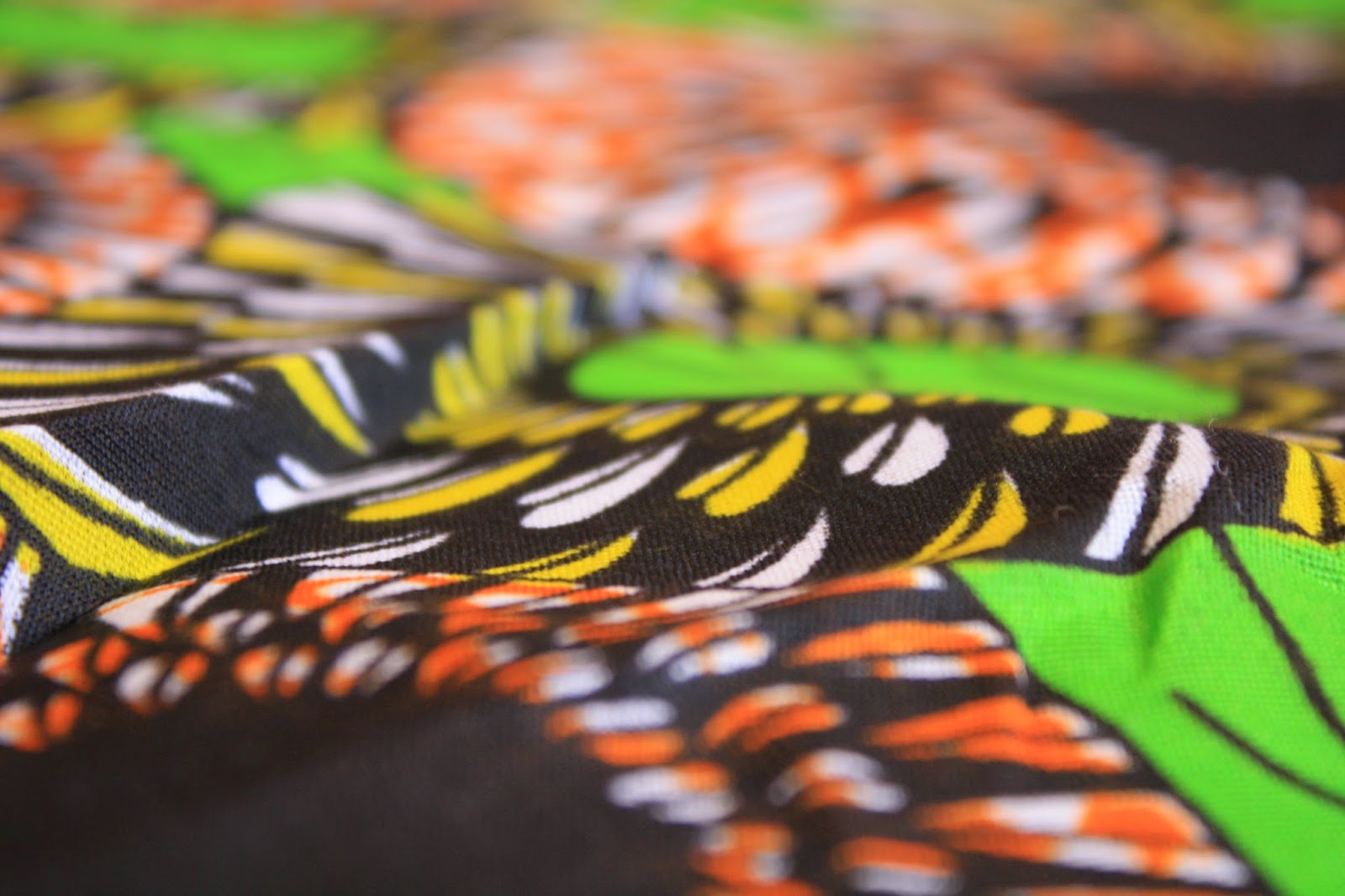
A new obsession: textiles

When I arrived in Kenya, I knew that tailoring was common, and I had the plan to get an outfit made for me.  I had no idea that within days I would become totally obsessed with textiles and start a collection that will definitely make packing to return home difficult. 

The first thing I found were khangas, or lesos (machekas in South Africa).  These are cheap cotton pieces of fabric that are used for literally everything.  You can carry a baby, carry your groceries, wear it as a wrap, have a picnic on it, get clothing made… anything.  There is a growing market of people making craft and high fashion items like shoes and purses covered in patterned khangas, which are really cool.  They are usually printed in two bright, contrasting colors and have a saying on them in Kiswahili.   When you buy them, you get two pieces that are a few yards long each, for about three dollars. 
from left: Mumias town, Lodwar, Lodwar, Johannesburg, Mombasa
During my first field trip to Kakamega, I had one goal, and that was to buy a khanga to remember my time there.  While you don’t see them as much in Nairobi, every woman in Mumias town was wearing or carrying a khanga of some sort.  I bought my first one, a blue and orange piece that said “UKIPATA SHUKURA HATA MIMI” which means something like “when you receive, also give me thanks.”  I wrote the place and date I purchased it on the edge and decided I would have to collect one every time I traveled.

number one


By now I have collected quite a few and gotten one in Kakamega, Turkana, Nairobi, and Johannesburg.  Sonia also brought me one from Mombasa, and I have been collecting some to give as gifts.

DRC skirt
My next obsession came in the form of kitenge.  Vitenge are printed with a batik technique and come in a ton of colors and patterns, like khangas.  Unlike khangas, the pattern doesn’t end or have a border, but is repeated on the bolt.  It is used to make outfits and purses and all kinds of good stuff.  Sonia took me to a store called Amani ya Juu in Riverside and I got a skirt made of a kitenge from DRC. 

kitenge from Joburg

a "few" examples
In South Africa, I discovered shweshwe.  Shweshwe is a thick, printed cotton fabric.  It was originally dyed with indigo, and much of the fabric available is still primarily blue and brown.  Each piece is made up of a single color, with a dark shade, a lighter one, and white, forming an often circular-based pattern.  The acid discharge roller printing technique used to create the patterns leave the fabrics with a distinctive smell and stiffness.  The fabric is used for many things, but is frequently made into short-sleeved, full skirted dresses.  I got a few examples, in traditional blue, brown, and one in special green.  UPDATE: I WENT BACK AND GOT MORE
easily my favorite
details

the famous Da Gama seal

African waxprints are very common is West Africa, but as Joburg is a hub, everything is available there.  I stocked up on a couple while I had the chance.
wax print
My plan when I return to Kenya is to get a few yards of kitenge and have an outfit made.  Any comments or suggestions?  Let me know!


Monday, December 15, 2014

Poor but happy?

Even though I’m in a very good mood today, I have decided my new blog will be a rant.  A rant about “poor but happy,”  the phrase I have heard many, many times.  No, I am not working on poverty alleviation as such, but when people talk to me about traveling and working with underprivileged communities, I hear this phrase a lot.  Usually it is a nice, upbeat commentary about traveling in the “third world.” 

“It is so eye-opening!  You see these people that have so little, but they are still so happy!  Their lives are so simple.  It makes me reconsider my busy life with email, iphones, dinner dates and deadlines.  Maybe they have figured out something that we don’t know.”

And I’m here to say:  I have no idea what it is like to be poor, but I have a sneaking suspicion that it does not, in fact, make you happy.  Nor is life simpler.  At all. 

Take, for example, drinking water.  I would say those of us in the developed world have things a bit simpler when it comes to opening the tap, filling a glass, and drinking some water.  If you live in many parts of the world with running water, you still have to boil it to render it potable, which takes a lot of time and energy (yours and the stuff you pay a lot for).  Maybe you don’t have running water or a borehole, and you have to go collect water, which can take a huge chunk out of your productive workday and take a whole lot of effort.  If you have to carry your water, you are probably going to use a lot less of it, meaning you spend a good portion of your life pretty dehydrated.  This would not make me happy. 


Besides the extra difficulties in conducting and everyday life that most poor people deal with, they still have the stressors that we do.  They still worry about work, school, boyfriends, etc.  Maybe their life seems more “pure” to us because they aren’t worried about selecting the wine with the correct terroir, or waiting in line for the new iphone, but they probably spend just as much time and more energy waiting in line at the borehole. 

Monday, December 1, 2014

The 9 to 5 Life and Me

For one month, I will be living the 9 to 5 office life of a real, grown-up adult-style person.  Let’s see how this goes. 

I have gotten pretty used to setting my own schedule so far in Kenya, so leaving for work at 7 was a bit of a struggle for me the first few days, but I am getting used to it.  At 7:30 every morning I check in at the Rennie House in Braamfontein and head up to the 14th floor to the HO offices.  This is one of the taller buildings in Braamfontein and the view is amazing.  From my desk I can see the entire Wits University campus and the posh suburbs of Joburg.  It all feels so grown-up and I felt out of place and awkward until the rest of the staff rolled in on my first day.  The staff is largely female, and either young and devastatingly hip or super-hippie.  Lots of drop-crotch pants and flowy colours and shweshwe in the office.  Not to say that everyone isn't super-professional—these people get a LOT accomplished—but the atmosphere is really chill and cool.  Also, there is a fancy cappuccino making machine that I have become quite fond of.
view from my desk

My job during the first week was taking stories from the beginning to the end of the publishing cycle, which has many, many steps and requires a lot of attention to detail.  I love it.  It goes something like thing: collect the final versions of a story in the L1 (first language, mother tongue, home tongue), get the translation into English, Zulu, Afrikaans, or Kiswahili (L2, lingua franca), and create a metadata form with all translations of the story, author/illustrator names, host organization and copyright information, dates, etc.  This is the master page for the story so there is no room for error!  Then I collect all the illustrations, make sure they are high-res, and create a powerpoint layout of the text and images in each language that looks nice.  All this hardcopy information then needs to be loaded onto the organization’s sharepoint so it can be accessed by everyone.  Now the real fun begins!  Publishing!  Did I say fun?  I meant excruciatingly tedious.  I need to upload each image onto our website’s image database and fill in a ton of information for each image—colors used, keywords, type, category, size, book reference, shape, file type, name… it takes a few minutes to do each image, and we are talking hundreds of images for the stories on my roster.  Once all the images are up, I use our story builder app, referencing the layouts on the powerpoint I made, and publish a finalized story!  I have published six so far (38 to go!) and you can check them out if you a tiny bit of investigation online.
I am also checking the 120+ stories in our database to make sure all images are available on the HO sharepoint and online, all metadata are correct, and the story “family trees” of the various language translations are linking properly online.  This is a big task!  I am also presenting on my work at the pilot sites during out year-end wrap up and doing several other tasks, so I am very occupied. 

To cap it all off, when I get home at night I am working on my master’s paper for Heller… I am a busy lady for these few weeks, but it feels pretty good to be truly tired when I lay down at night.